WP_Query Object
(
[query] => Array
(
[post_type] => post
[posts_per_page] => 3
[post_status] => publish
[orderby] => rand
)
[query_vars] => Array
(
[post_type] => post
[posts_per_page] => 3
[post_status] => publish
[orderby] => rand
[error] =>
[m] =>
[p] => 0
[post_parent] =>
[subpost] =>
[subpost_id] =>
[attachment] =>
[attachment_id] => 0
[name] =>
[pagename] =>
[page_id] => 0
[second] =>
[minute] =>
[hour] =>
[day] => 0
[monthnum] => 0
[year] => 0
[w] => 0
[category_name] =>
[tag] =>
[cat] =>
[tag_id] =>
[author] =>
[author_name] =>
[feed] =>
[tb] =>
[paged] => 0
[meta_key] =>
[meta_value] =>
[preview] =>
[s] =>
[sentence] =>
[title] =>
[fields] => all
[menu_order] =>
[embed] =>
[category__in] => Array
(
)
[category__not_in] => Array
(
)
[category__and] => Array
(
)
[post__in] => Array
(
)
[post__not_in] => Array
(
)
[post_name__in] => Array
(
)
[tag__in] => Array
(
)
[tag__not_in] => Array
(
)
[tag__and] => Array
(
)
[tag_slug__in] => Array
(
)
[tag_slug__and] => Array
(
)
[post_parent__in] => Array
(
)
[post_parent__not_in] => Array
(
)
[author__in] => Array
(
)
[author__not_in] => Array
(
)
[search_columns] => Array
(
)
[ignore_sticky_posts] =>
[suppress_filters] =>
[cache_results] => 1
[update_post_term_cache] => 1
[update_menu_item_cache] =>
[lazy_load_term_meta] => 1
[update_post_meta_cache] => 1
[nopaging] =>
[comments_per_page] => 50
[no_found_rows] =>
[order] =>
)
[tax_query] => WP_Tax_Query Object
(
[queries] => Array
(
)
[relation] => AND
[table_aliases:protected] => Array
(
)
[queried_terms] => Array
(
)
[primary_table] => wp_posts
[primary_id_column] => ID
)
[meta_query] => WP_Meta_Query Object
(
[queries] => Array
(
)
[relation] =>
[meta_table] =>
[meta_id_column] =>
[primary_table] =>
[primary_id_column] =>
[table_aliases:protected] => Array
(
)
[clauses:protected] => Array
(
)
[has_or_relation:protected] =>
)
[date_query] =>
[request] => SELECT SQL_CALC_FOUND_ROWS wp_posts.ID
FROM wp_posts
WHERE 1=1 AND wp_posts.post_type = 'post' AND ((wp_posts.post_status = 'publish'))
ORDER BY RAND()
LIMIT 0, 3
[posts] => Array
(
[0] => WP_Post Object
(
[ID] => 5065
[post_author] => 4
[post_date] => 2026-09-01 14:03:32
[post_date_gmt] => 2026-09-01 18:03:32
[post_content] =>
Applications are now open for the 12th BioREACH Award Program from the Center for Biotechnology, which provides $50,000 in translational research funding for Stony Brook faculty and postdoctoral researchers to generate the evidence needed to advance promising innovations to the next stage of development.
BioREACH funds milestone-driven studies and welcomes biomedical innovations as well as platforms, tools, computational technologies, and other enabling technologies with the potential to contribute to solutions addressing unmet needs in health.
Application deadline: October 29, 2026, 5:00pm ET
For info sessions, eligibility and deadlines visit our REACH Website and FAQ.
The Center for Biotechnology (CfB) has helped advance some of Stony Brook University’s most impactful biomedical innovations, among them the yeast two-hybrid system, Xiaflex®, ReoPro®, Oracea®, and 3D virtual colonoscopy. The CfB has supported more than 475 faculty-led translational research projects and contributed to 306 license agreements generating $51 million in royalty returns to the University.
Questions? Reach out to our program contacts or sign up for office hours:
Dee Dao, PhD, Associate Director, dee.dao@stonybrook.edu
Office Hours: Monday–Friday, 2–3:30 PM | Sign up Here
Zelda Mendelowitz, PhD, Venture Associate, zelda.mendelowitz@stonybrook.edu
Office Hours: Tuesday, Wednesday, Friday, 8–11 AM | Sign up Here
[post_title] => BioREACH: Translational Research Funding Opportunity
[post_excerpt] =>
[post_status] => publish
[comment_status] => open
[ping_status] => open
[post_password] =>
[post_name] => bioreach-translational-research-funding-opportunity
[to_ping] =>
[pinged] =>
[post_modified] => 2026-09-04 11:55:36
[post_modified_gmt] => 2026-09-04 15:55:36
[post_content_filtered] =>
[post_parent] => 0
[guid] => https://centerforbiotechnology.org/?p=5065
[menu_order] => 0
[post_type] => post
[post_mime_type] =>
[comment_count] => 0
[filter] => raw
)
[1] => WP_Post Object
(
[ID] => 3658
[post_author] => 3
[post_date] => 2021-03-22 14:57:42
[post_date_gmt] => 2021-03-22 14:57:42
[post_content] =>
Tools that accelerate medical countermeasure screening and development are vital to improving human health – from enabling personalized medicine to responding to health security threats such as pandemics. To this end, BARDA, in partnership with the National Center for Advancing Translational Sciences (NCATS), part of the National Institutes of Health, has launched the new ImmuneChip+ program.
We aim to partner with innovators to support the development of advanced microphysiological systems / tissue chip platforms that integrate a component of the human immune system. The objective of the program is to develop a set of set of mature ImmuneChips, combining a previously validated model of a vital human tissue (e.g. lung, heart, kidney) with an immune system component, in a single platform that can be machine-manufactured and that includes multiple in-line sensors for long-term tissue monitoring. With this program, we aim to further enhance the usability of tissue chips and position them as useful tools in the drug development process and for personalized therapeutics.
For more details, please visit BARDA DRIVe program at https://drive.hhs.gov/immunechip.html
[post_title] => BARDA: Immunechip+ Program Overview
[post_excerpt] =>
[post_status] => publish
[comment_status] => open
[ping_status] => open
[post_password] =>
[post_name] => barda-immunechip-program-overview
[to_ping] =>
[pinged] =>
[post_modified] => 2021-03-22 15:01:19
[post_modified_gmt] => 2021-03-22 15:01:19
[post_content_filtered] =>
[post_parent] => 0
[guid] => https://centerforbiotechnology.org/?p=3658
[menu_order] => 53
[post_type] => post
[post_mime_type] =>
[comment_count] => 0
[filter] => raw
)
[2] => WP_Post Object
(
[ID] => 3128
[post_author] => 4
[post_date] => 2019-01-11 19:49:30
[post_date_gmt] => 2019-01-11 19:49:30
[post_content] => The Biomedical Advanced Research and Development Authority (BARDA) is leading an interagency group to develop a wearable device to detect, and possibly treat, an opioid overdose. This group, Technology Innovation to Combat Opioids (TICO) is holding a Deep Dive on Feb 12-13, 2019 to review possible technologies being developed in this area. Specifically, they are looking for wearables or software as a medical device that are no larger than the palm of your hand and measure a physiological response indicative of an opioid overdose. Examples of possible markers that could be incorporated into the device include, but are not limited to, respiratory rate, blood carbon dioxide or oxygen content, brain activity and opioid levels. The device should have the ability to alert potential caretakers nearby that the wearer is in distress and, potentially, have the capability to dispense a treatment for the overdose event. The technologies should be at a maturity level capable of undergoing pivotal clinical trials in 2020.
TICO invites anyone with an innovative idea in this space to submit a 1-2 page summary of their device that addresses the following items:
- Provide a high-level device description including how the device detects possible opioid overdose.
- How does the device notify potential caretakers? Does it notify people nearby? If so, how?
- Description of the user population and use environment?
- What are the performance limitations for the device?
- How does the device treat an opioid overdose if that is a feature?
- Do you own the intellectual property for this technology?
TICO will review each submission and invite selected participants to present their technology at the Deep Dive on Feb 12-13, 2019. Travel funding is not available, however, this meeting will serve as market research for the solicitation that will be issued by BARDA to fund the clinical study.
Accommodations can also be made for a virtual presentation. Submissions and questions can be sent to Kristen Herring Kristen.herring@hhs.gov and should be received no later than Jan. 22nd.
[post_title] => BARDA: TICO Deep Dive 2 Announcement
[post_excerpt] => The Biomedical Advanced Research and Development Authority (BARDA) is leading an interagency group to develop a wearable device to detect, and possibly treat, an opioid overdose. This group invites anyone with an innovative idea in this space to submit a 1-2 page summary of their device.
[post_status] => publish
[comment_status] => open
[ping_status] => open
[post_password] =>
[post_name] => barda-tico-deep-dive-2
[to_ping] =>
[pinged] =>
[post_modified] => 2019-04-09 14:41:18
[post_modified_gmt] => 2019-04-09 14:41:18
[post_content_filtered] =>
[post_parent] => 0
[guid] => http://centerforbiotechnology.org/?p=3128
[menu_order] => 105
[post_type] => post
[post_mime_type] =>
[comment_count] => 0
[filter] => raw
)
[3] => WP_Post Object
(
[ID] => 2621
[post_author] => 3
[post_date] => 2017-03-20 13:58:38
[post_date_gmt] => 2017-03-20 13:58:38
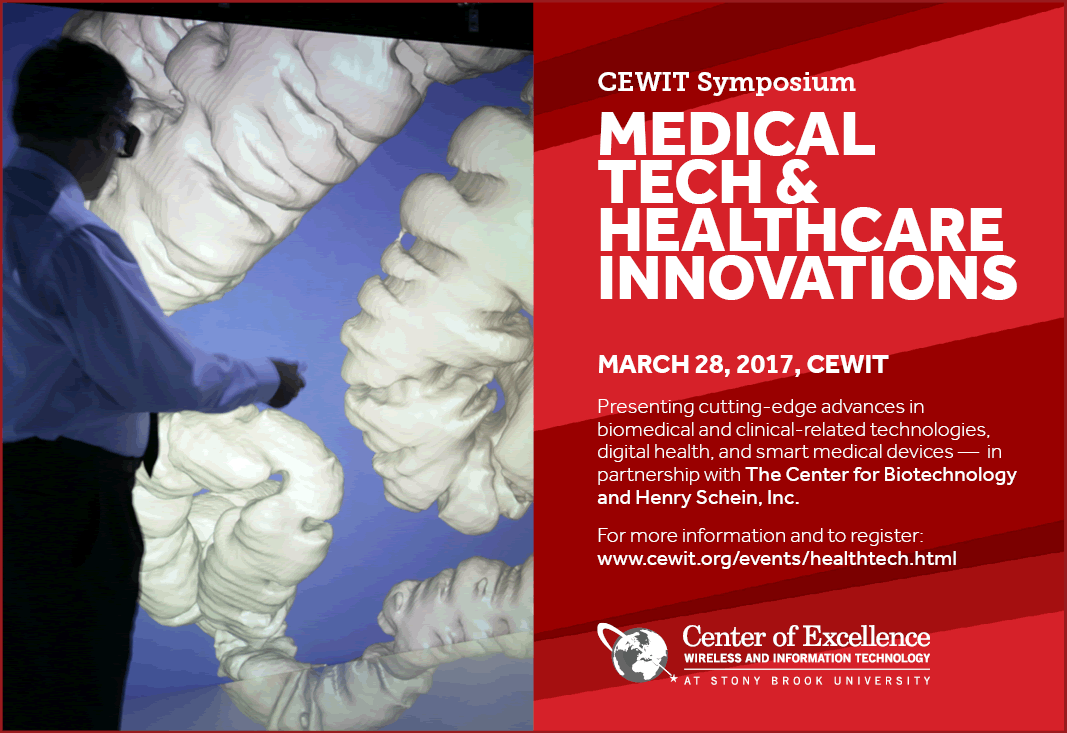
[post_content] => CEWIT, the Center for Biotechnology and Henry Schein, Inc., have joined forces to host an expert symposium presenting cutting-edge advances in biomedical and clinical-related technologies, digital health, and smart medical devices, focusing on the technology as well as the joint industry, academic, and R&D partnerships that are integral to major innovations in the healthtech domain — at Stony Brook University.
Tuesday, March 28, 2017, 9:30am-3:30pm
The Center of Excellence in Wireless and Information Technology (CEWIT) at Stony Brook University
1500 Stony Brook Road, Stony Brook, NY 11794-6040
Event is free but registration is requires. View full agenda and register here: www.cewit.org/events/healthtech.html
 [post_title] => CEWIT Medical Technologies and Healthcare Innovations Symposium
[post_excerpt] => Featuring cutting-edge advances in biomedical and clinical-related technologies, digital health, and smart medical devices, focusing on the technology as well as the joint industry, academic, and R&D partnerships that are integral to major innovations in the healthtech domain — at Stony Brook University.
[post_status] => publish
[comment_status] => open
[ping_status] => open
[post_password] =>
[post_name] => cewit-medical-technologies-and-healthcare-innovations-symposium
[to_ping] =>
[pinged] =>
[post_modified] => 2017-03-20 13:59:29
[post_modified_gmt] => 2017-03-20 13:59:29
[post_content_filtered] =>
[post_parent] => 0
[guid] => http://centerforbiotechnology.org/?p=2621
[menu_order] => 151
[post_type] => post
[post_mime_type] =>
[comment_count] => 0
[filter] => raw
)
)
[post_count] => 4
[current_post] => -1
[before_loop] => 1
[in_the_loop] =>
[post] => WP_Post Object
(
[ID] => 5065
[post_author] => 4
[post_date] => 2026-09-01 14:03:32
[post_date_gmt] => 2026-09-01 18:03:32
[post_content] =>
[post_title] => CEWIT Medical Technologies and Healthcare Innovations Symposium
[post_excerpt] => Featuring cutting-edge advances in biomedical and clinical-related technologies, digital health, and smart medical devices, focusing on the technology as well as the joint industry, academic, and R&D partnerships that are integral to major innovations in the healthtech domain — at Stony Brook University.
[post_status] => publish
[comment_status] => open
[ping_status] => open
[post_password] =>
[post_name] => cewit-medical-technologies-and-healthcare-innovations-symposium
[to_ping] =>
[pinged] =>
[post_modified] => 2017-03-20 13:59:29
[post_modified_gmt] => 2017-03-20 13:59:29
[post_content_filtered] =>
[post_parent] => 0
[guid] => http://centerforbiotechnology.org/?p=2621
[menu_order] => 151
[post_type] => post
[post_mime_type] =>
[comment_count] => 0
[filter] => raw
)
)
[post_count] => 4
[current_post] => -1
[before_loop] => 1
[in_the_loop] =>
[post] => WP_Post Object
(
[ID] => 5065
[post_author] => 4
[post_date] => 2026-09-01 14:03:32
[post_date_gmt] => 2026-09-01 18:03:32
[post_content] =>
Applications are now open for the 12th BioREACH Award Program from the Center for Biotechnology, which provides $50,000 in translational research funding for Stony Brook faculty and postdoctoral researchers to generate the evidence needed to advance promising innovations to the next stage of development.
BioREACH funds milestone-driven studies and welcomes biomedical innovations as well as platforms, tools, computational technologies, and other enabling technologies with the potential to contribute to solutions addressing unmet needs in health.
Application deadline: October 29, 2026, 5:00pm ET
For info sessions, eligibility and deadlines visit our REACH Website and FAQ.
The Center for Biotechnology (CfB) has helped advance some of Stony Brook University’s most impactful biomedical innovations, among them the yeast two-hybrid system, Xiaflex®, ReoPro®, Oracea®, and 3D virtual colonoscopy. The CfB has supported more than 475 faculty-led translational research projects and contributed to 306 license agreements generating $51 million in royalty returns to the University.
Questions? Reach out to our program contacts or sign up for office hours:
Dee Dao, PhD, Associate Director, dee.dao@stonybrook.edu
Office Hours: Monday–Friday, 2–3:30 PM | Sign up Here
Zelda Mendelowitz, PhD, Venture Associate, zelda.mendelowitz@stonybrook.edu
Office Hours: Tuesday, Wednesday, Friday, 8–11 AM | Sign up Here
[post_title] => BioREACH: Translational Research Funding Opportunity
[post_excerpt] =>
[post_status] => publish
[comment_status] => open
[ping_status] => open
[post_password] =>
[post_name] => bioreach-translational-research-funding-opportunity
[to_ping] =>
[pinged] =>
[post_modified] => 2026-09-04 11:55:36
[post_modified_gmt] => 2026-09-04 15:55:36
[post_content_filtered] =>
[post_parent] => 0
[guid] => https://centerforbiotechnology.org/?p=5065
[menu_order] => 0
[post_type] => post
[post_mime_type] =>
[comment_count] => 0
[filter] => raw
)
[comment_count] => 0
[current_comment] => -1
[found_posts] => 286
[max_num_pages] => 96
[max_num_comment_pages] => 0
[is_single] =>
[is_preview] =>
[is_page] =>
[is_archive] =>
[is_date] =>
[is_year] =>
[is_month] =>
[is_day] =>
[is_time] =>
[is_author] =>
[is_category] =>
[is_tag] =>
[is_tax] =>
[is_search] =>
[is_feed] =>
[is_comment_feed] =>
[is_trackback] =>
[is_home] => 1
[is_privacy_policy] =>
[is_404] =>
[is_embed] =>
[is_paged] =>
[is_admin] =>
[is_attachment] =>
[is_singular] =>
[is_robots] =>
[is_favicon] =>
[is_posts_page] =>
[is_post_type_archive] =>
[query_vars_hash:WP_Query:private] => 325c4f9f1aebaa5ec90666fa54175ba0
[query_vars_changed:WP_Query:private] =>
[thumbnails_cached] =>
[allow_query_attachment_by_filename:protected] =>
[stopwords:WP_Query:private] =>
[compat_fields:WP_Query:private] => Array
(
[0] => query_vars_hash
[1] => query_vars_changed
)
[compat_methods:WP_Query:private] => Array
(
[0] => init_query_flags
[1] => parse_tax_query
)
[query_cache_key:WP_Query:private] =>
)