WP_Query Object
(
[query] => Array
(
[post_type] => post
[posts_per_page] => 3
[post_status] => publish
[orderby] => rand
)
[query_vars] => Array
(
[post_type] => post
[posts_per_page] => 3
[post_status] => publish
[orderby] => rand
[error] =>
[m] =>
[p] => 0
[post_parent] =>
[subpost] =>
[subpost_id] =>
[attachment] =>
[attachment_id] => 0
[name] =>
[pagename] =>
[page_id] => 0
[second] =>
[minute] =>
[hour] =>
[day] => 0
[monthnum] => 0
[year] => 0
[w] => 0
[category_name] =>
[tag] =>
[cat] =>
[tag_id] =>
[author] =>
[author_name] =>
[feed] =>
[tb] =>
[paged] => 0
[meta_key] =>
[meta_value] =>
[preview] =>
[s] =>
[sentence] =>
[title] =>
[fields] => all
[menu_order] =>
[embed] =>
[category__in] => Array
(
)
[category__not_in] => Array
(
)
[category__and] => Array
(
)
[post__in] => Array
(
)
[post__not_in] => Array
(
)
[post_name__in] => Array
(
)
[tag__in] => Array
(
)
[tag__not_in] => Array
(
)
[tag__and] => Array
(
)
[tag_slug__in] => Array
(
)
[tag_slug__and] => Array
(
)
[post_parent__in] => Array
(
)
[post_parent__not_in] => Array
(
)
[author__in] => Array
(
)
[author__not_in] => Array
(
)
[search_columns] => Array
(
)
[ignore_sticky_posts] =>
[suppress_filters] =>
[cache_results] => 1
[update_post_term_cache] => 1
[update_menu_item_cache] =>
[lazy_load_term_meta] => 1
[update_post_meta_cache] => 1
[nopaging] =>
[comments_per_page] => 50
[no_found_rows] =>
[order] =>
)
[tax_query] => WP_Tax_Query Object
(
[queries] => Array
(
)
[relation] => AND
[table_aliases:protected] => Array
(
)
[queried_terms] => Array
(
)
[primary_table] => wp_posts
[primary_id_column] => ID
)
[meta_query] => WP_Meta_Query Object
(
[queries] => Array
(
)
[relation] =>
[meta_table] =>
[meta_id_column] =>
[primary_table] =>
[primary_id_column] =>
[table_aliases:protected] => Array
(
)
[clauses:protected] => Array
(
)
[has_or_relation:protected] =>
)
[date_query] =>
[request] => SELECT SQL_CALC_FOUND_ROWS wp_posts.ID
FROM wp_posts
WHERE 1=1 AND wp_posts.post_type = 'post' AND ((wp_posts.post_status = 'publish'))
ORDER BY RAND()
LIMIT 0, 3
[posts] => Array
(
[0] => WP_Post Object
(
[ID] => 5065
[post_author] => 4
[post_date] => 2026-09-01 14:03:32
[post_date_gmt] => 2026-09-01 18:03:32
[post_content] =>
Applications are now open for the 12th BioREACH Award Program from the Center for Biotechnology, which provides $50,000 in translational research funding for Stony Brook faculty and postdoctoral researchers to generate the evidence needed to advance promising innovations to the next stage of development.
BioREACH funds milestone-driven studies and welcomes biomedical innovations as well as platforms, tools, computational technologies, and other enabling technologies with the potential to contribute to solutions addressing unmet needs in health.
Application deadline: October 29, 2026, 5:00pm ET
For info sessions, eligibility and deadlines visit our REACH Website and FAQ.
The Center for Biotechnology (CfB) has helped advance some of Stony Brook University’s most impactful biomedical innovations, among them the yeast two-hybrid system, Xiaflex®, ReoPro®, Oracea®, and 3D virtual colonoscopy. The CfB has supported more than 475 faculty-led translational research projects and contributed to 306 license agreements generating $51 million in royalty returns to the University.
Questions? Reach out to our program contacts or sign up for office hours:
Dee Dao, PhD, Associate Director, dee.dao@stonybrook.edu
Office Hours: Monday–Friday, 2–3:30 PM | Sign up Here
Zelda Mendelowitz, PhD, Venture Associate, zelda.mendelowitz@stonybrook.edu
Office Hours: Tuesday, Wednesday, Friday, 8–11 AM | Sign up Here
[post_title] => BioREACH: Translational Research Funding Opportunity
[post_excerpt] =>
[post_status] => publish
[comment_status] => open
[ping_status] => open
[post_password] =>
[post_name] => bioreach-translational-research-funding-opportunity
[to_ping] =>
[pinged] =>
[post_modified] => 2026-09-04 11:55:36
[post_modified_gmt] => 2026-09-04 15:55:36
[post_content_filtered] =>
[post_parent] => 0
[guid] => https://centerforbiotechnology.org/?p=5065
[menu_order] => 0
[post_type] => post
[post_mime_type] =>
[comment_count] => 0
[filter] => raw
)
[1] => WP_Post Object
(
[ID] => 2913
[post_author] => 4
[post_date] => 2018-01-10 15:34:32
[post_date_gmt] => 2018-01-10 15:34:32
[post_content] => Celmatix, a next-generation women’s health company, has been awarded $4.5 million from Empire State Development’s New York City Regional Economic Development Council (REDC), to expand its headquarters in Manhattan.
Piraye Yurttas Beim, PhD, Founder and CEO of Celmatix stated “New York State has been there for Celmatix every step of the way as we’ve transitioned from ambitious startup to innovative next generation women’s health company. From the training I received through New York State’s Center for Biotechnology program at Stony Brook University, to the support we received from the Empire State Development START-UP New York program when it was time to build our first lab, and now, with this award as we prepare to take the next step in the evolution of our company, we are honored to have continued support to grow and thrive in New York.”
Additional Articles: pharmiweb
[post_title] => Celmatix awarded $4.5M to expand in NYS
[post_excerpt] => Celmatix receives $4.5 million to expand its headquarters in Manhattan.
[post_status] => publish
[comment_status] => open
[ping_status] => open
[post_password] =>
[post_name] => celmatix-awarded-4-5m-to-expand-in-nys
[to_ping] =>
[pinged] =>
[post_modified] => 2018-02-02 19:23:34
[post_modified_gmt] => 2018-02-02 19:23:34
[post_content_filtered] =>
[post_parent] => 0
[guid] => http://centerforbiotechnology.org/?p=2913
[menu_order] => 128
[post_type] => post
[post_mime_type] =>
[comment_count] => 0
[filter] => raw
)
[2] => WP_Post Object
(
[ID] => 3181
[post_author] => 3
[post_date] => 2019-02-28 16:35:02
[post_date_gmt] => 2019-02-28 16:35:02
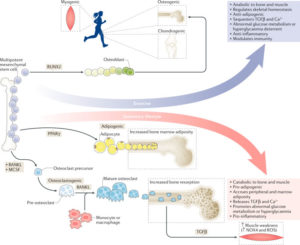
[post_content] => Center for Biotechnology Director Dr. Clinton Rubin has co-authored a recent article published in Nature Reviews Endocrinology "“Combating osteoporosis and obesity with exercise: leveraging cell mechanosensitivity”. Abstract below, full article here.
Abstract:
Osteoporosis, a condition of skeletal decline that undermines quality of life, is treated with pharmacological interventions that are associated with poor adherence and adverse effects. Complicating efforts to improve clinical outcomes, the incidence of obesity is increasing, predisposing the population to a range of musculoskeletal complications and metabolic disorders. Pharmacological management of obesity has yet to deliver notable reductions in weight and debilitating complications are rarely avoided. By contrast, exercise shows promise as a non-invasive and non-pharmacological method of regulating both osteoporosis and obesity. The principal components of exercise — mechanical signals — promote bone and muscle anabolism while limiting formation and expansion of fat mass. Mechanical regulation of bone and marrow fat might be achieved by regulating functions of differentiated cells in the skeletal tissue while biasing lineage selection of their common progenitors — mesenchymal stem cells. An inverse relationship between adipocyte versus osteoblast fate selection from stem cells is implicated in clinical conditions such as childhood obesity and increased marrow adiposity in type 2 diabetes mellitus, as well as contributing to skeletal frailty. Understanding how exercise-induced mechanical signals can be used to improve bone quality while decreasing fat mass and metabolic dysfunction should lead to new strategies to treat chronic diseases such as osteoporosis and obesity.
 [post_title] => “Combating osteoporosis and obesity with exercise: leveraging cell mechanosensitivity”
[post_excerpt] =>
[post_status] => publish
[comment_status] => open
[ping_status] => open
[post_password] =>
[post_name] => combating-osteoporosis-and-obesity-with-exercise-leveraging-cell-mechanosensitivity
[to_ping] =>
[pinged] =>
[post_modified] => 2019-04-09 14:40:26
[post_modified_gmt] => 2019-04-09 14:40:26
[post_content_filtered] =>
[post_parent] => 0
[guid] => https://centerforbiotechnology.org/?p=3181
[menu_order] => 100
[post_type] => post
[post_mime_type] =>
[comment_count] => 0
[filter] => raw
)
[3] => WP_Post Object
(
[ID] => 1643
[post_author] => 4
[post_date] => 2015-09-15 18:44:52
[post_date_gmt] => 2015-09-15 18:44:52
[post_content] => Independently documented economic impact: $1.2 Billion
Jobs created: 1,125
New corporate revenues: $812 Million
Supported additional funding: $238 Million
Center for Biotechnology documented economic impact over recent fifteen-year period
Perhaps it is numbers like these which best illustrate the success CFB has had on the biotechnology industry and economy.
And perhaps they contributed to the redesignation of the CFB as a Center for Advanced Technology for ten years by the New York State Foundation for Science, Technology and Innovation (NYSTAR) as a Center for Advanced Technology (CAT).
The New York State redesignation recognizes the impact of the CFB over 30 years driving innovation toward commercial goals and resulting in accelerated product development cycles "from bench to boardroom to bedside." It recognizes the key role played by the CFB in facilitating a regional bioscience innovation ecosystem, collaborating with Stony Brook University, Cold Spring Harbor Laboratory, and Brookhaven National Laboratory.
The redesignation by New York State validates all of the work we have done over the last 10-year period to create the foundation for exponential growth. We would not have secured the National Institutes of Health REACH award without it, says Clint Rubin, Director of the Center for Biotechnology."The REACH designation represents an $8.1M investment in technology development, commercialization, and new company formation. Visionary's like New York State Senator Kenneth La Valle deserve the credit. They recognized thirty years ago that universities represented a largely untapped pool of innovation and economic potential.
Strikingly, it validates and provides the foundation for the new Long Island Bioscience Hub (LIBH), a CFB-led initiative to formally bring these institutions together to foster technology development, commercialization, and new company formation. The LIBH is a bold step made possible by a partnership with the National Institute of Health REACH initiative (Research Evaluation and Commercialization Hub). The NIH award places the CFB in the national spotlight along with other elite institutions. (Read more on the NIH REACH award here)
"This redesignation occurs in an interesting and changing environment, where varying elements in the regional, state, and national biotech ecosystem are aligning. There is a confluence of events and issues that are creating a unique opportunity to build the biotech economy in the region and across the State." Commented Diane Fabel, Director of Operations, CFB. "We have learned a lot about the process of moving academic innovation into the commercial sector over time. And there have been such tremendous scientific advances recently that represent new commercial opportunities and life saving technologies. There is still much to learn and do, and it is an incredibly exciting time to be doing it.
[post_title] => Center for Biotechnology Redesignated by New York State: 'Unique Time of Change and Growth'
[post_excerpt] => The New York State redesignation recognizes the impact of the CFB over 30 years driving innovation toward commercial goals and resulting in accelerated product development cycles from bench to boardroom to bedside.
[post_status] => publish
[comment_status] => open
[ping_status] => open
[post_password] =>
[post_name] => center-for-biotechnology-redesignated-by-new-york-state-unique-time-of-change-and-growth
[to_ping] =>
[pinged] =>
http://centerforbiotechnology.org/new/center-for-biotech-receives-nih-award-to-develop-a-bioscience-hub/
[post_modified] => 2016-03-02 17:48:17
[post_modified_gmt] => 2016-03-02 17:48:17
[post_content_filtered] =>
[post_parent] => 0
[guid] => http://centerforbiotechnology.org/new/?p=1643
[menu_order] => 200
[post_type] => post
[post_mime_type] =>
[comment_count] => 0
[filter] => raw
)
)
[post_count] => 4
[current_post] => -1
[before_loop] => 1
[in_the_loop] =>
[post] => WP_Post Object
(
[ID] => 5065
[post_author] => 4
[post_date] => 2026-09-01 14:03:32
[post_date_gmt] => 2026-09-01 18:03:32
[post_content] =>
[post_title] => “Combating osteoporosis and obesity with exercise: leveraging cell mechanosensitivity”
[post_excerpt] =>
[post_status] => publish
[comment_status] => open
[ping_status] => open
[post_password] =>
[post_name] => combating-osteoporosis-and-obesity-with-exercise-leveraging-cell-mechanosensitivity
[to_ping] =>
[pinged] =>
[post_modified] => 2019-04-09 14:40:26
[post_modified_gmt] => 2019-04-09 14:40:26
[post_content_filtered] =>
[post_parent] => 0
[guid] => https://centerforbiotechnology.org/?p=3181
[menu_order] => 100
[post_type] => post
[post_mime_type] =>
[comment_count] => 0
[filter] => raw
)
[3] => WP_Post Object
(
[ID] => 1643
[post_author] => 4
[post_date] => 2015-09-15 18:44:52
[post_date_gmt] => 2015-09-15 18:44:52
[post_content] => Independently documented economic impact: $1.2 Billion
Jobs created: 1,125
New corporate revenues: $812 Million
Supported additional funding: $238 Million
Center for Biotechnology documented economic impact over recent fifteen-year period
Perhaps it is numbers like these which best illustrate the success CFB has had on the biotechnology industry and economy.
And perhaps they contributed to the redesignation of the CFB as a Center for Advanced Technology for ten years by the New York State Foundation for Science, Technology and Innovation (NYSTAR) as a Center for Advanced Technology (CAT).
The New York State redesignation recognizes the impact of the CFB over 30 years driving innovation toward commercial goals and resulting in accelerated product development cycles "from bench to boardroom to bedside." It recognizes the key role played by the CFB in facilitating a regional bioscience innovation ecosystem, collaborating with Stony Brook University, Cold Spring Harbor Laboratory, and Brookhaven National Laboratory.
The redesignation by New York State validates all of the work we have done over the last 10-year period to create the foundation for exponential growth. We would not have secured the National Institutes of Health REACH award without it, says Clint Rubin, Director of the Center for Biotechnology."The REACH designation represents an $8.1M investment in technology development, commercialization, and new company formation. Visionary's like New York State Senator Kenneth La Valle deserve the credit. They recognized thirty years ago that universities represented a largely untapped pool of innovation and economic potential.
Strikingly, it validates and provides the foundation for the new Long Island Bioscience Hub (LIBH), a CFB-led initiative to formally bring these institutions together to foster technology development, commercialization, and new company formation. The LIBH is a bold step made possible by a partnership with the National Institute of Health REACH initiative (Research Evaluation and Commercialization Hub). The NIH award places the CFB in the national spotlight along with other elite institutions. (Read more on the NIH REACH award here)
"This redesignation occurs in an interesting and changing environment, where varying elements in the regional, state, and national biotech ecosystem are aligning. There is a confluence of events and issues that are creating a unique opportunity to build the biotech economy in the region and across the State." Commented Diane Fabel, Director of Operations, CFB. "We have learned a lot about the process of moving academic innovation into the commercial sector over time. And there have been such tremendous scientific advances recently that represent new commercial opportunities and life saving technologies. There is still much to learn and do, and it is an incredibly exciting time to be doing it.
[post_title] => Center for Biotechnology Redesignated by New York State: 'Unique Time of Change and Growth'
[post_excerpt] => The New York State redesignation recognizes the impact of the CFB over 30 years driving innovation toward commercial goals and resulting in accelerated product development cycles from bench to boardroom to bedside.
[post_status] => publish
[comment_status] => open
[ping_status] => open
[post_password] =>
[post_name] => center-for-biotechnology-redesignated-by-new-york-state-unique-time-of-change-and-growth
[to_ping] =>
[pinged] =>
http://centerforbiotechnology.org/new/center-for-biotech-receives-nih-award-to-develop-a-bioscience-hub/
[post_modified] => 2016-03-02 17:48:17
[post_modified_gmt] => 2016-03-02 17:48:17
[post_content_filtered] =>
[post_parent] => 0
[guid] => http://centerforbiotechnology.org/new/?p=1643
[menu_order] => 200
[post_type] => post
[post_mime_type] =>
[comment_count] => 0
[filter] => raw
)
)
[post_count] => 4
[current_post] => -1
[before_loop] => 1
[in_the_loop] =>
[post] => WP_Post Object
(
[ID] => 5065
[post_author] => 4
[post_date] => 2026-09-01 14:03:32
[post_date_gmt] => 2026-09-01 18:03:32
[post_content] =>
Applications are now open for the 12th BioREACH Award Program from the Center for Biotechnology, which provides $50,000 in translational research funding for Stony Brook faculty and postdoctoral researchers to generate the evidence needed to advance promising innovations to the next stage of development.
BioREACH funds milestone-driven studies and welcomes biomedical innovations as well as platforms, tools, computational technologies, and other enabling technologies with the potential to contribute to solutions addressing unmet needs in health.
Application deadline: October 29, 2026, 5:00pm ET
For info sessions, eligibility and deadlines visit our REACH Website and FAQ.
The Center for Biotechnology (CfB) has helped advance some of Stony Brook University’s most impactful biomedical innovations, among them the yeast two-hybrid system, Xiaflex®, ReoPro®, Oracea®, and 3D virtual colonoscopy. The CfB has supported more than 475 faculty-led translational research projects and contributed to 306 license agreements generating $51 million in royalty returns to the University.
Questions? Reach out to our program contacts or sign up for office hours:
Dee Dao, PhD, Associate Director, dee.dao@stonybrook.edu
Office Hours: Monday–Friday, 2–3:30 PM | Sign up Here
Zelda Mendelowitz, PhD, Venture Associate, zelda.mendelowitz@stonybrook.edu
Office Hours: Tuesday, Wednesday, Friday, 8–11 AM | Sign up Here
[post_title] => BioREACH: Translational Research Funding Opportunity
[post_excerpt] =>
[post_status] => publish
[comment_status] => open
[ping_status] => open
[post_password] =>
[post_name] => bioreach-translational-research-funding-opportunity
[to_ping] =>
[pinged] =>
[post_modified] => 2026-09-04 11:55:36
[post_modified_gmt] => 2026-09-04 15:55:36
[post_content_filtered] =>
[post_parent] => 0
[guid] => https://centerforbiotechnology.org/?p=5065
[menu_order] => 0
[post_type] => post
[post_mime_type] =>
[comment_count] => 0
[filter] => raw
)
[comment_count] => 0
[current_comment] => -1
[found_posts] => 286
[max_num_pages] => 96
[max_num_comment_pages] => 0
[is_single] =>
[is_preview] =>
[is_page] =>
[is_archive] =>
[is_date] =>
[is_year] =>
[is_month] =>
[is_day] =>
[is_time] =>
[is_author] =>
[is_category] =>
[is_tag] =>
[is_tax] =>
[is_search] =>
[is_feed] =>
[is_comment_feed] =>
[is_trackback] =>
[is_home] => 1
[is_privacy_policy] =>
[is_404] =>
[is_embed] =>
[is_paged] =>
[is_admin] =>
[is_attachment] =>
[is_singular] =>
[is_robots] =>
[is_favicon] =>
[is_posts_page] =>
[is_post_type_archive] =>
[query_vars_hash:WP_Query:private] => 325c4f9f1aebaa5ec90666fa54175ba0
[query_vars_changed:WP_Query:private] =>
[thumbnails_cached] =>
[allow_query_attachment_by_filename:protected] =>
[stopwords:WP_Query:private] =>
[compat_fields:WP_Query:private] => Array
(
[0] => query_vars_hash
[1] => query_vars_changed
)
[compat_methods:WP_Query:private] => Array
(
[0] => init_query_flags
[1] => parse_tax_query
)
[query_cache_key:WP_Query:private] =>
)